
What a Passive Cooling System Actually Looks Like
When people say “passive cooling,” they don’t mean a single gizmo tucked in a corner. A passive cooling system is a thoughtful assembly of design choices — architectural form, materials, landscaping and simple physics — that together keep buildings comfortable with little or no energy input. Think of it as designing the house to work with climate, rather than fighting it.


1. Shading and solar control (stop heat before it gets in)
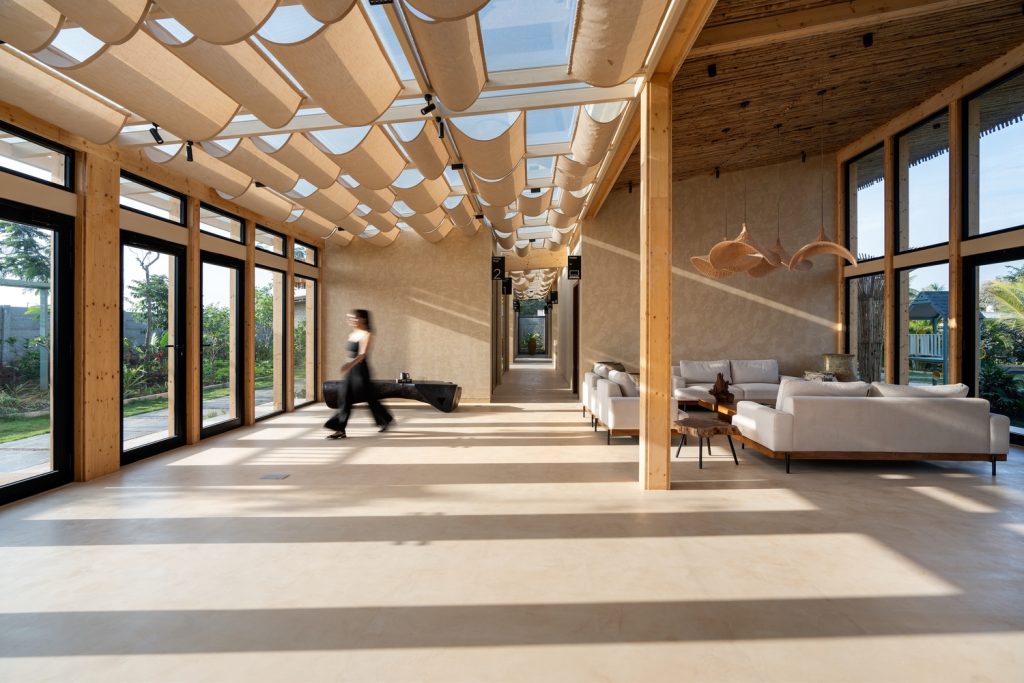
The simplest piece of a passive system is shading: eaves, louvers, pergolas, and smart glazing that stop direct sun from hitting windows and walls during hot months. External shading reduces solar gains dramatically and is the first line of defense in almost every passive design toolkit. Research reviews classify solar control as a core passive strategy for lowering indoor heat load.


2. Thermal mass and night purging (store coolness, dump heat)
Thermal mass — concrete, rammed earth, tile or thick masonry — soaks up daytime heat and releases it when temperatures fall. Paired with night-purging ventilation (open windows or vents after sunset), thermal mass lets buildings shed stored heat overnight and stay cool through the next day. Studies show optimised internal thermal mass plus buoyancy-driven ventilation can considerably reduce or remove a need for air conditioning in many climates.

Image: Queensland Heritage Register

3. Natural ventilation (use wind and buoyancy for airflow)
A well-designed passive cooling system includes strategies for cross-ventilation and stack (buoyancy) ventilation: window placement, high and low openings, atria and shafts that encourage warm air to rise and be pulled out while cooler air enters. ASHRAE’s design guidance highlights natural ventilation as a mainstream, engineered approach — not just ‘open a window and hope.’ Properly modelled, it’s a predictable way to cut indoor temperatures and increase comfort.

4. Evaporative cooling (use water smartly where climate allows)
In dry climates, direct and indirect evaporative cooling (think water-cooled pads or membranes) can provide robust passive cooling with tiny power needs. The IEA and recent studies map how indirect evaporative systems are already used to shrink mechanical loads in arid regions — and new membrane research shows promise for passive, low-energy cooling in data centers and other heat-intensive settings. Evaporative approaches must be matched to humidity and water availability to be effective and sustainable.
5. Radiative cooling and material innovation (send heat to the sky)
An exciting frontier is radiative cooling: materials that reflect sunlight and emit thermal infrared radiation through the atmospheric window to outer space, cooling surfaces even during daytime. Recent reviews and high-profile papers highlight radiative cooling’s potential and the challenge of taking lab materials into real rooftops and façades — but it’s already moving from experiment toward practical applications.


6. Vegetation and microclimate (make the surroundings part of the system)
Trees, green roofs and water features reduce local temperatures and block solar gain. Landscape design is not decorative here — it’s an active component of the cooling system that shapes microclimate and airflow.
7. Hybrid thinking and smart sequencing
Real buildings mix strategies: shading + thermal mass + night purge + selective reflective surfaces + greenery. Modern passive design also integrates phase-change materials (PCMs) to extend thermal buffering and uses simulation tools to size components for local climates. Recent literature shows these integrated approaches offer the largest, most reliable gains.


So what does it look like on a real building?
Imagine a simple house: wide north-facing eaves, operable high clerestory windows for stack ventilation, thick tiled floors that absorb daytime heat, a shaded courtyard with deciduous trees, and white reflective roof materials. In a dry inland town you might add an indirect evaporative pre-cooling unit; in a coastal wet climate you’d prioritize ventilation and shading over evaporative methods.
Passive cooling is not a single product you bolt on — it’s architecture, materials and landscape arranged to let climate become an asset. When done well it reduces energy demand, improves resilience in heatwaves, and reconnects occupants to natural rhythms: nights that can be opened up for cool breezes, days that rely on shade and stored coolness.
If you want deeper technical reading, start with reviews on radiative cooling and passive strategies, ASHRAE’s natural ventilation guidance, and the IEA work on evaporative cooling — all of which show both the promise and the climate-sensitivity of passive solutions.
Passive cooling isn’t about nostalgia or losing control — it’s about designing with humility and intelligence. Climate isn’t something to beat; it’s the partner we learn to read. When buildings treat climate as an asset, they become cooler, cheaper to run, and more humane to live in.